


.svg)

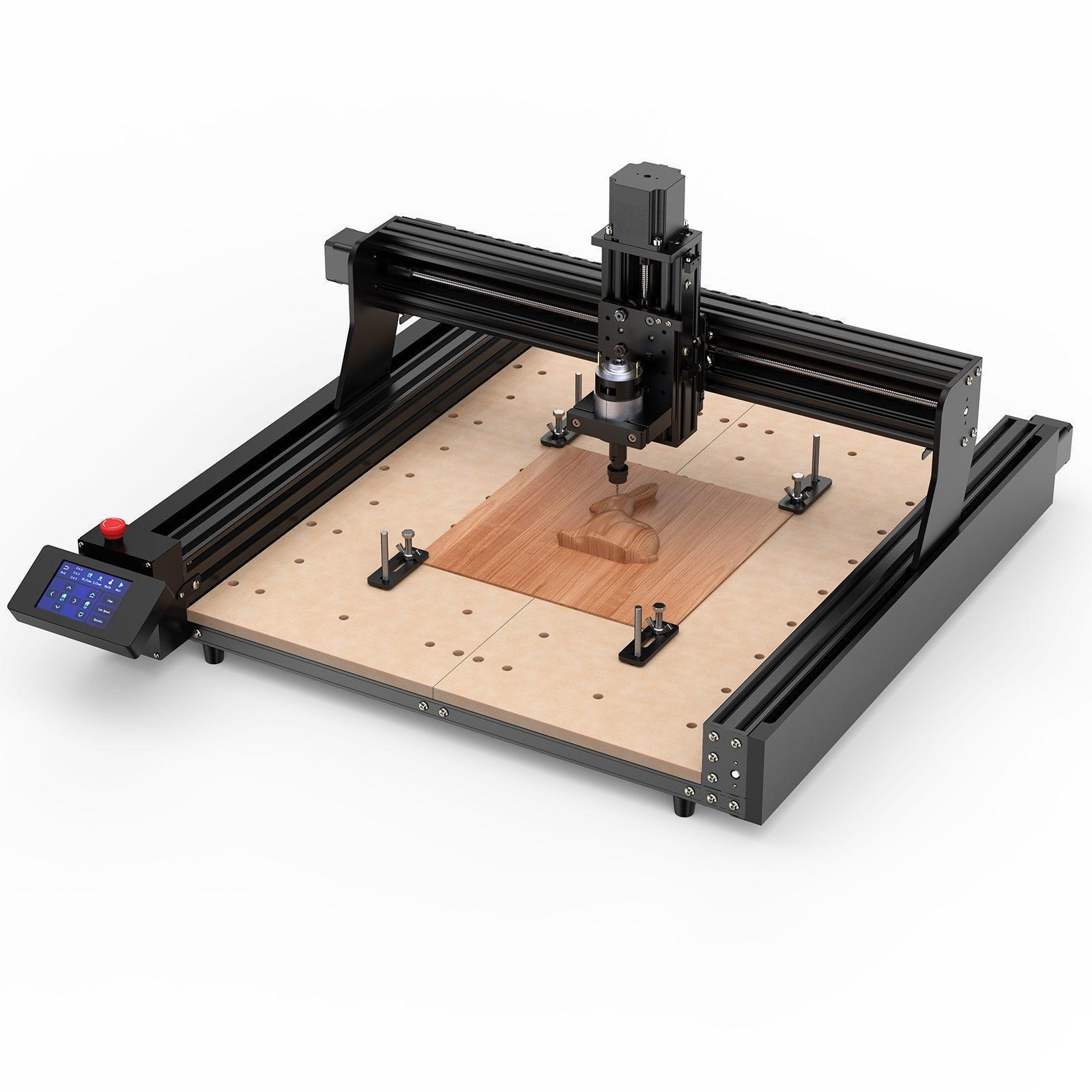
The TTC450 CNC is Two Trees' 460 x 460 x 80mm desktop router, built around an 8000 RPM spindle. It uses a NEMA23 stepper (17HS8401S, 20mN.m) and a T8 acme lead screw drive (2mm pitch, 4mm lead, 5 start) on all axes.
Every cut starts with one formula: Feed Rate = Spindle Speed (RPM) x Chip Load x Number of Cutting Edges (flutes). Chip load is the thickness of material each cutting edge removes in one revolution of the bit. This number comes from the manufacturer of the bit, which publishes a chip-load chart for each bit diameter and material. Look up your exact bit and material, start from the middle of the published range, and you have the third number in the formula. The chart below shows the recommended spindle speed for each material and bit type.
The TTC450's spindle tops out at 8000 RPM, below most of the chart. Leave it at 8000 for everything and control the cut with feed rate; if a material like acrylic starts to melt, speed the feed up rather than trying to slow the spindle further. Depth per pass is where the machine's build matters. A truly rigid machine with a powerful spindle can cut as deep as the bit is wide in a single pass, but that takes real spindle torque, a drive train and clamps that hold firm, a gantry that will not flex, and enough mass to soak up vibration. This is a lead-screw desktop machine, so take shallower passes: push too deep and the bit deflects and chatters, leaving scalloped edges, or it rubs instead of cutting and burns the material. The fastest way to dial in a cut is to see what has already worked for other people.
Worked example for feed rate: 1/8in (3.175mm) two-flute solid carbide end mill in hard wood. The chart says 16,000 RPM, but this spindle tops out at 8000 RPM, so run 8000. With the bit maker's 0.025mm per tooth (0.0010 in): 8000 x 0.025 x 2 = 400 mm/min (16 in/min) feed. For depth per pass, start shallow and check Community Cut Settings in Easel for what works on this machine. If the cut sounds strained, reduce the depth, not the feed. Slowing the feed below the chip load makes the bit rub instead of cut.
Community Cut Settings shows the spindle speed, feed rate, and depth per pass other makers actually run for your machine, material, and bit.
The TTC450 CNC runs GRBL_ESP32, confirmed via Two Trees' own TTC450 Wiki. Easel's live control, the Easel Driver and Rapid Connect, works with classic GRBL and FluidNC over USB, so it does not carve this machine in real time. Use Easel to design and generate toolpaths, then export the G-code and run it from the machine's own controller: its standalone touchscreen, the ESP3D web interface, or an SD/TF card. Because Easel's G-code is standard GRBL, it runs as-is. Select TTC450 CNC in Easel's machine menu to size the canvas to its 460 x 460 x 80mm working area.
Try Easel Free →
Create your free Easel account and connect your machine in minutes.
Easel Free Trial →